GEOMETRIC EXPRESSIONISM
April
18-May 25, 1991
Chris
Blades / Max Banbury / Ron Falcioni / Jas. W. Felter
Leo
Labelle
/ Frank Lambert / Gordon Payne / Gregg Simpson
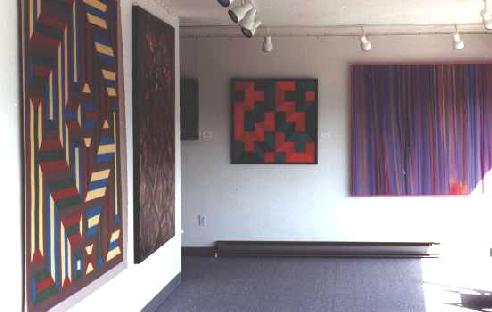 Works by
Jas
W. Felter and Gregg Simpson
Works by
Jas
W. Felter and Gregg Simpson
Geometric Expressionism celebrates the intuitive and personal
aspects of works in the tradition of
non-objective,
hard-edge geometric painting. Since the public furore over the National
Gallery's purchase of Barnett Newman's
Voice of
Fire in 1990, formalist art has come under attack, perhaps
because
its appreciation requires an awareness of the roots of
abstraction. The exhibition at the Gallery Alpha confronts these
questions
with a selection of work by artists who draw upon a variety
of sources from indigenous art and pre-historic designs to futuristic
patternings
and illusionism.
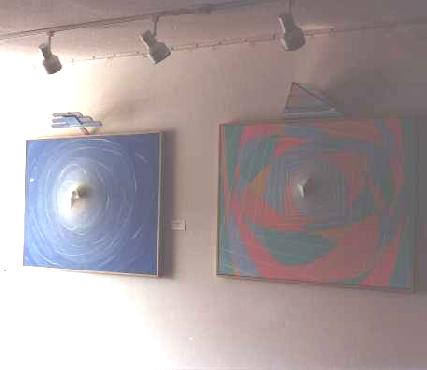 Mixed media canvases by Frank Lambert
The
roots of geometric expressionism
(a term coined by contributing artist Jas. Felter) reach back to early
abstractionists such as
Wassily Kandinsky and Frank Kupka who pioneered improvisation
with
pure colours and shapes. Both artists also drew on their
metaphysical knowledge and became transitional
figures
from Symbolism to abstraction,
painters
who could provide a
theoretical and philosophic structure to their abstractions.
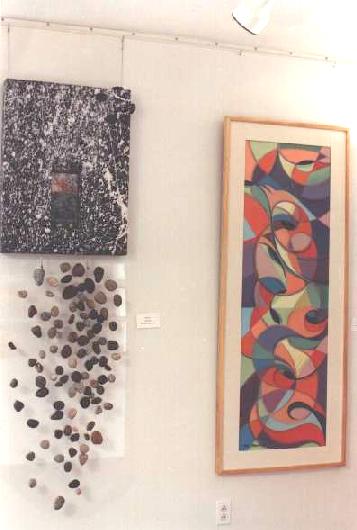
Works by Gordon Payne-lt.; Max Banbury-rt.
In Geometric Expressionism, the link with the
metaphysical
is reflected in each artist's personal
interpretation
of the
traditions of geometric abstraction. As a
result,
their work provides a more animated,
less cerebral alternative to the
minimalism often associated with geometric
art.